Category: Blog

Your blog category

  • Millet, Van Gogh and What I’m Learning About Repetition

    Millet, Van Gogh and What I’m Learning About Repetition

    I’m writing this I take a break from ruining a painting I’d just started.

    I’d drawn the image in 6b pencil onto heavy paper and completely forgot to gesso it first. The thinned paint soaked straight in and drowned the drawing before I’d got anywhere with it. So I stopped, gessoed five more sheets to make sure I’ve always got primed paper ready, and sat down to write instead.

    My Old Dog

    So the image I was drawing – my old dog.  At the ripe age of 13 he has suddenly gone deaf and it made me realise how old he actually is as he still looks and acts like a pup.  So whilst he is still around I thought I would set about painting him. 

    I am currently re-reading a book about the repetitions Van Gogh made throughout his painting life.  It’s a really great book as it details the how’s and the possible ‘why’s’ Van Gogh painted what he did.  A technique that was discovered was that Gogh liked to make repetitions and drawings from life using a grid.  So I had taken a lovely picture of my dog and drew him on the ‘unprimed’ paper, drowning him in thinner and a touch a raw umber.

    I may have ruined this image but what I noticed was how intently I copied him and how I noticed things I hadn’t noticed before.  How big his black nose is, how his eyes slightly drop into the friendliest dog eyes.  His character is of unbound energy and curiosity without a harmful bone in his body.

    The next day I drew him again, on primed paper this time with a successful undercoat of yellow ochre and Liquin.  Inspired by Van Gogh I may make 2.  One which is realistic, the first sitting.  Then I will paint from this painting a second version, a repetition with techniques and colours similar to what I think Van Gogh would use.
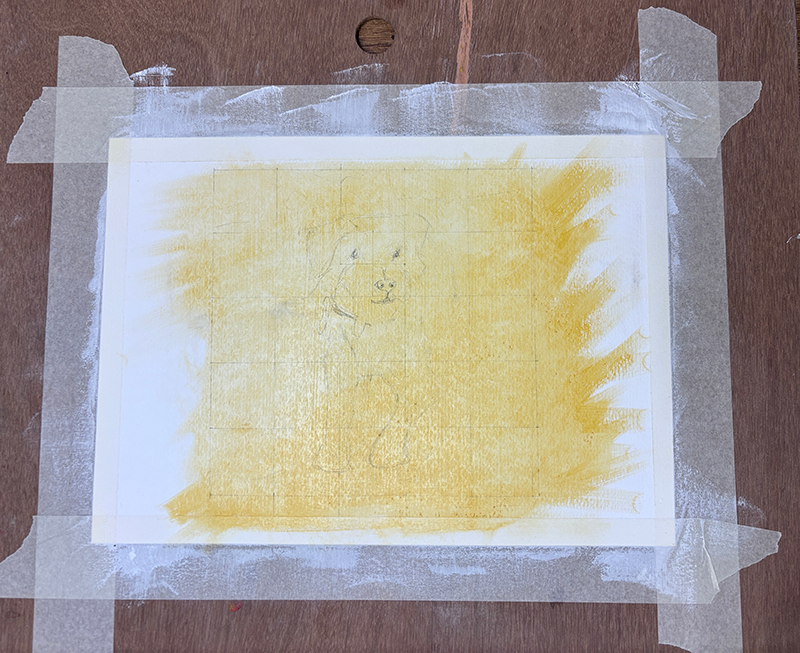
    A new drawing with a undercoat made of yellow ochre and Liquin at about 50:50 ratio.

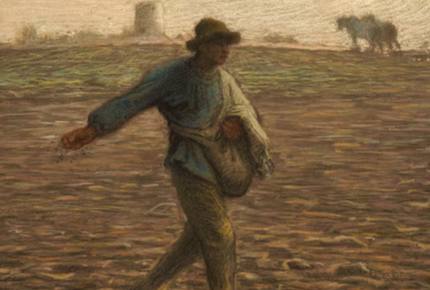
    I’m almost finished reading Van Gogh Repetitions, (I’ll add a link at the end if you are interested in acquiring a copy). I also have learnt that Van Gogh was deeply inspired by Jean-Francois Millet, a French artist who specialised and was deeply attached to country life in France. Van Gogh did a few paintings after Millet such as The Sower.  It wasn’t a direct replication, however close, and completed in Van Gogh’s style.  Before reading this it didn’t occur to me that the greats copied one another. Doing a bit of research it seemed copying one another’s images, either to learn or as appreciation was quite frequent among many. Dali also took inspiration from Millet, as did many impressionists following.

    Introduction to Jean-Francois Millet

    Millet was inspired by Japanese Wood prints, as Van Gogh was towards the latter end of his painting. In fact there were quite a few references Van Gogh had taken from Millet.  Millet was known as The ‘Fauve’ (great beast) of modern art. I started reading ‘Millet and Modern Art’ on Internet Archive (I nearly bought the book but am trying to lessen my consumption of buying!) and the connection between how inspired artists were by other artists is a lot closer than I thought.  Millet in return was inspired by Nicolas Poussin. It goes back to the saying ‘Nothing is Original’ by Jim Jarmusch. This is the part that fascinates me. Studying both the visual connection between artists’ way of working but also the meaning behind their work. The hows and the whys.

    My Art Progress – Butterfly No.1

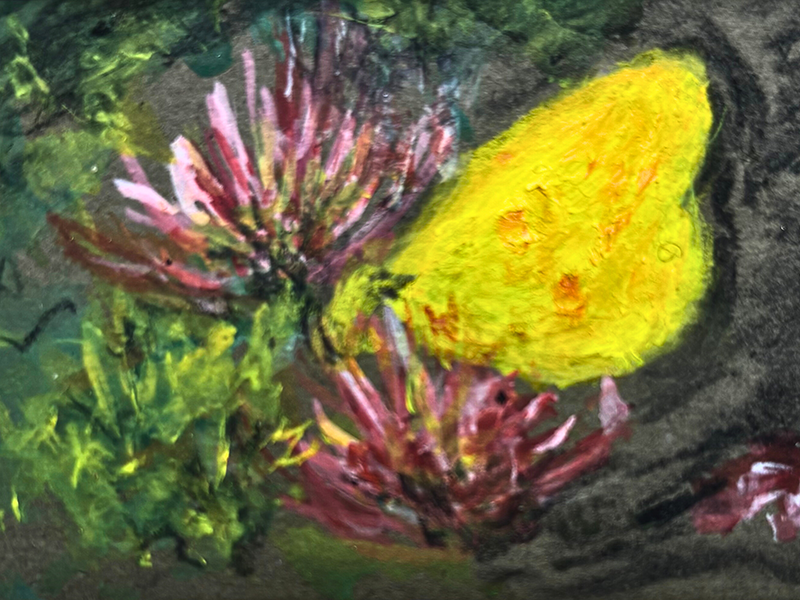
    I have also finished Butterfly No.1 which is on my homepage.  I was undecided whether it was finished and thought about going into it more and working into it further but I think I will leave it for now. I may come back to it later.

    Links to further reading and Watching


    Millet and Modern Art.
    https://www.biblio.com/book/van-gogh-repetitions-rathbone-eliza-robinson/d/1746147408?srsltid=AfmBOooScd7cU20eHLUbRrXHxm8P8T14XVvdrC1pF3yWlaDcxsmQIV5bMFo

    Below is a link to a YouTube video from The National Gallery talking about Nicholas Poussin as ‘The painters painter.
    https://www.google.com/search?q=Nicholas+Poussin&rlz=1C5OZZY_enGB1170GB1172&oq=Nicholas+Poussin&gs_lcrp=EgZjaHJvbWUyBggAEEUYOTILCAEQLhgKGAsYgAQyCwgCEAAYChgLGIAEMgsIAxAAGAoYCxiABDILCAQQABgKGAsYgAQyCwgFEAAYChgLGIAEMgsIBhAAGAoYCxiABDILCAcQABgKGAsYgAQyCwgIEAAYChgLGIAE0gEINDIzMWowajeoAgCwAgA&sourceid=chrome&source=chrome.ob&ie=UTF-8#fpstate=ive&vld=cid:c8608e78,vid:3ckw3GAD130,st:0

    As I was writing this I received an email from ‘Paint Coach’, a wonderful painter who offers free courses on painting tutorials. This week was about dog paintings so will be worth a watch.

    Good bye for now.

  • Old Pages, Old Signs: Looking for Inspiration Off Pinterest

    Old Pages, Old Signs: Looking for Inspiration Off Pinterest

    I read a lot and I always have done and I think that reading these days has become rather more important than I realised it would be because it seems to be the one thing that stops my ideas from all looking rather the same as everyone else’s.

    You see it is tremendously easy nowadays to open Pinterest and type in whatever subject you happen to be working on and within a matter of moments you will have a hundred versions of precisely the same idea served back to you and it is all very efficient and practical but I have come to realise that it is rather a trap if I am being honest with you. When everyone is drawing from the same boards and the same trending searches and the same handful of accounts that everyone else is looking at then everything begins to look rather like everything else and that is not really what I want for my own work at all.

    So somewhere along the way I stopped starting there and instead I began going back to books and to the places where books live and second-hand bookstores especially have become rather special to me. There is something quite wonderful about a shop full of other people’s old paperbacks with their cracked spines and someone’s handwriting in the margins and perhaps a bus ticket used as a bookmark twenty years ago and Pinterest simply cannot give you that feeling at all. Nobody has already turned it into a mood board or filtered it through a thousand other people’s opinions. It is just sitting there waiting quietly to be noticed.

    I have also started to photograph old shop signs whenever I come across them and I find there is a whole history of craftsmanship sitting on the front of these buildings that nobody ever designed with a trend in mind. The hand-painted lettering and the slightly wonky kerning and the colours that have faded in a way that no filter could ever fake properly and quite often I do not even know what the shop used to sell but that does not really matter to me.

    This love of old things has taken me further into history generally and not just as a subject to know about but as an actual source of ideas and inspiration. Stories from decades or centuries ago and the way people dressed and wrote and the way they approached their problems without any of the tools we take for granted now and I find that far more interesting and far more honest than anything currently circulating on the internet.

    I do not think there is anything wrong with Pinterest if I am being fair but I have found that the more time I spend in second-hand bookshops and standing in front of old shop signs taking far too many photographs the more original my own work begins to feel and reading slows me down in much the same way. A good book does not hand you an idea all neatly formed and ready to use but rather it gives you a world to sit in for a while and I usually come out the other side of it with something I would not have found any other way at all.

    This is where I shall be sharing more of that and the books and the bookshops and the old signage and the bits of history that keep pulling at my attention. Thank you for reading this one.

  • Learning to See: What Painting Has Taught Me About Colour

    Learning to See: What Painting Has Taught Me About Colour

    I used to think I understood colour. I had studied art at college, at foundational level and also took a degree based design course. Entering the professional world my designs were never questioned for my use of colour so I thought I must of been ok. That was until one day when presenting a piece of work, a peer at the time absolutely bulldozed into me about my lack of understanding of colour. That day 15ish years ago hit hard and it still does. It’s not recently many years later that I have a bit of time to look at honing my use of colour.

    Staring at a screen for many years using colour screen is one thing. Colour mixed on a palette, responding to the light in a room, sitting next to another colour that changes how you perceive it – that’s something else entirely. My artwork has become the place where I’m slowly, sometimes frustratingly, learning to really see colour. This is where I see myself learning about colours.

    One of the biggest shifts has been learning that colour is relational. A yellow next to grey looks completely different from the same yellow next to purple. Value, how light or dark a colour is, often matters more than the hue itself. And temperature, whether a colour leans warm or cool, changes the whole mood of a piece before I’ve even settled on what I’m painting.

    I’ve also learned to slow down. Mixing the exact shade I’m after usually takes several attempts, and most of what I’ve learned has come from getting it wrong: a muddy mix, a colour that fights with everything around it, a painting that just doesn’t sit right until I figure out why. Each mistake has taught me something a colour wheel never could.

    The strange thing is, this has changed how I see the world outside the studio too. I notice the blue-grey of shadows on a wall, the way autumn light shifts everything warmer, colours I would have walked past a few years ago. That’s the part I didn’t expect: that learning to paint colour would change how I actually see.

    This blog will be where I share more of that process: the experiments, the mistakes, and what I’m learning along the way. Thanks for reading the first one.